Anthropic was founded in 2021 by Dario Amodei, Daniela Amodei, and a group of researchers who left OpenAI over disagreements about how fast to move and how seriously to take AI safety. The founding thesis was a contrarian one: that building AI more carefully, with safety and interpretability at the core of the research agenda, was not a constraint on commercial success but a source of it.
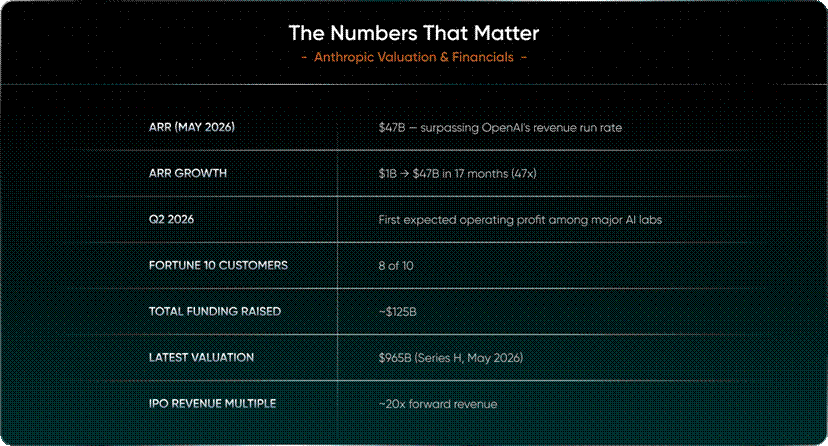
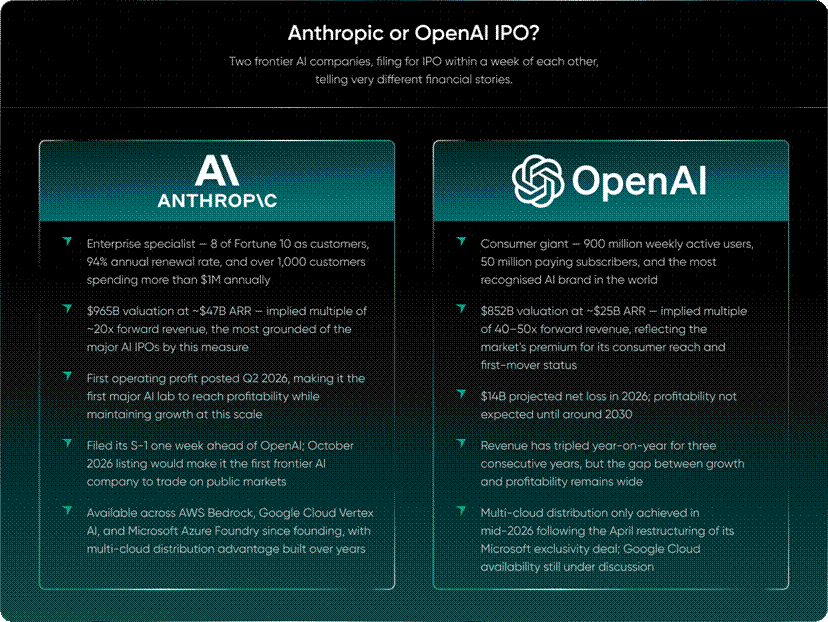
Four years later, that bet has paid off in ways that are difficult to overstate. Anthropic’s annualised revenue run rate went from $1 billion in December 2024 to $47 billion in May 2026, a 47x increase in 17 months. For context, Salesforce took approximately 20 years to reach $30 billion in annual revenue. Anthropic did it in under three years from a standing start. No technology company has grown this fast at this revenue scale.
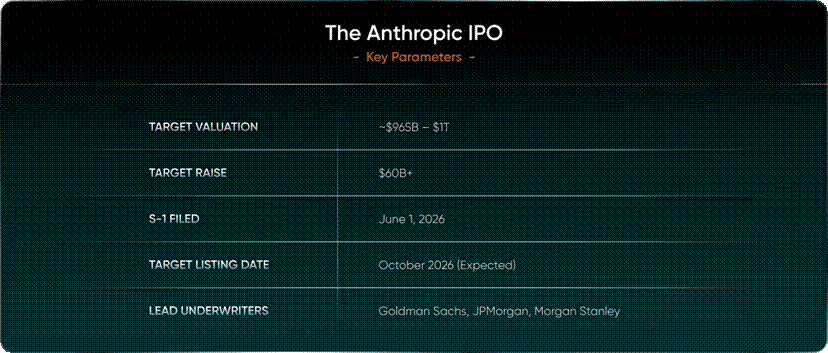
The company filed a confidential S-1 with the SEC on June 1, 2026, one week ahead of rival OpenAI. They are targeting an October 2026 listing on Nasdaq, which would make it the first major AI lab to reach public markets. At a $965 billion valuation following its $65 billion Series H in May 2026, it may also be the first AI company to debut above a $1 trillion market capitalisation.
Most investors encounter Anthropic through Claude. But the more important story for investors is structural: Anthropic has built something its competitors have not, an enterprise AI business with genuine, defensible switching costs.
Enterprise customers report that migrating away from Claude often requires rebuilding safety protocols and compliance frameworks from scratch, creating retention dynamics that do not exist for most software products. The result is a 94% annual enterprise renewal rate and over 1,000 customers spending more than $1 million annually on Claude, a figure that doubled in under two months as of April 2026.
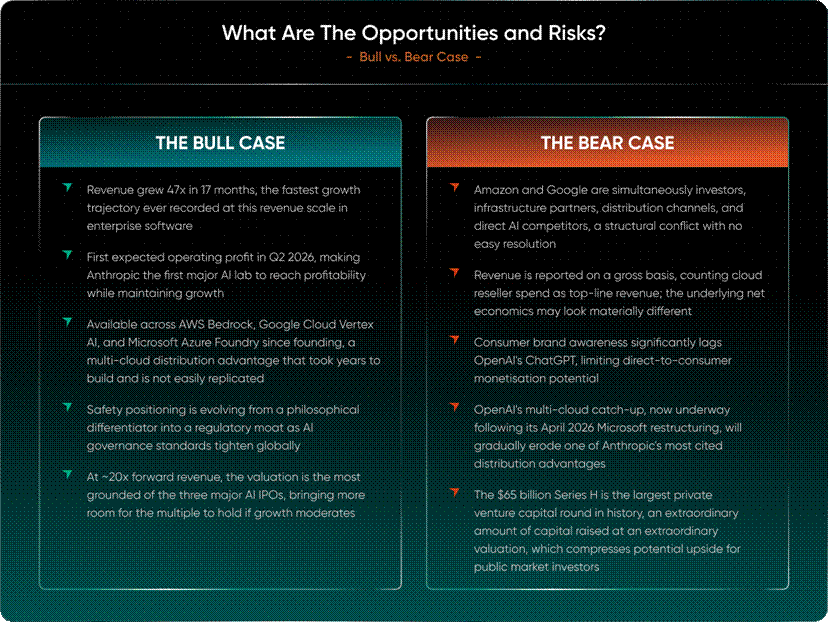
Claude is available across major cloud platforms, including AWS Bedrock, Google Cloud Vertex AI, and Microsoft Azure Foundry, meaning enterprise customers can run Claude wherever their infrastructure already lives. For large organisations with existing multi-cloud commitments, this removes one of the most common barriers to enterprise AI adoption and is a key reason why Anthropic’s enterprise penetration has compounded as rapidly as it has. OpenAI only broke free of its Azure exclusivity in April 2026, with its models reaching AWS Bedrock in June and Google Cloud distribution still reportedly under discussion. The gap is closing, but Anthropic locked in during the years OpenAI was Azure-only do not switch easily.
Then there is the safety positioning itself. As AI regulation intensifies globally, Anthropic’s early investment in constitutional AI and interpretability research increasingly looks less like a philosophical commitment and more like a regulatory moat. Enterprise customers in finance, healthcare, and legal are paying 3 to 4 times standard rates for Anthropic’s safety-certified model versions.
The last data point deserves emphasis. At roughly 20x forward revenue, Anthropic’s valuation multiple is meaningfully lower than OpenAI’s implied 35–45x and SpaceX’s 90x, a function of its faster near-term revenue ramp and the fact that it is approaching profitability. Whether that represents a more attractive entry point or simply reflects lower growth expectations is the central debate among institutional investors.
Anthropic’s two largest investors are also its two largest cloud infrastructure partners and its two largest distribution channels. Amazon has invested over $8 billion and sells Claude to enterprise customers through AWS Bedrock. Google has invested $3 billion and distributes Claude through Google Cloud Vertex AI. Anthropic has committed to spend over $100 billion on AWS compute over the next decade.
This is simultaneously a strength and a structural risk. The partnerships give Anthropic distribution at a scale no startup could build independently, and they have clearly driven the revenue acceleration. But they also create a concentration of dependency that is unusual even by tech standards. If the relationship with either partner deteriorated, the revenue impact would be immediate and significant.
There is also a competitive dimension that investors should not ignore. Amazon is also a major investor in OpenAI’s competitor Cohere. Google has its own Gemini models. Both companies are simultaneously Anthropic’s biggest customers and its most resourced competitors. The S-1, when public, will be closely scrutinised for how Anthropic characterises these relationships.
CNBC reported that Anthropic posted its first profitable quarter in Q2 2026, a meaningful milestone that distinguishes it from both OpenAI and SpaceX at the point of IPO. Whether that profitability is sustainable as compute commitments scale is the most important financial question the S-1 will need to answer.
Anthropic is generating nearly twice OpenAI’s revenue at a lower valuation, and has already posted its first profitable quarter. On purely quantitative grounds, Anthropic’s entry point is more defensible. OpenAI’s higher multiple reflects its stronger consumer brand, its first-mover advantage, and the market’s willingness to pay a premium for the name that started the generative AI category.
Vantage does not represent or warrant that the material provided here is accurate, current, or complete, and therefore should not be relied upon as such. The information provided here, whether from a third party or not, is not to be considered as a recommendation; or an offer to buy or sell; or the solicitation of an offer to buy or sell any financial instruments; or to participate in any specific trading strategy. Any research provided does not have regard to the specific investment objectives, financial situation and needs of any specific person who may receive it. We advise any readers of this content to seek their own advice. Without the approval of Vantage, reproduction or redistribution of this information is not permitted.


 About Us
 Premium Client
 Premium Perks
 Promotions
 Premium Trading


 Vantage Plus Research Team